An advanced Arduino-based platform for exploration, security, and research.
Overview
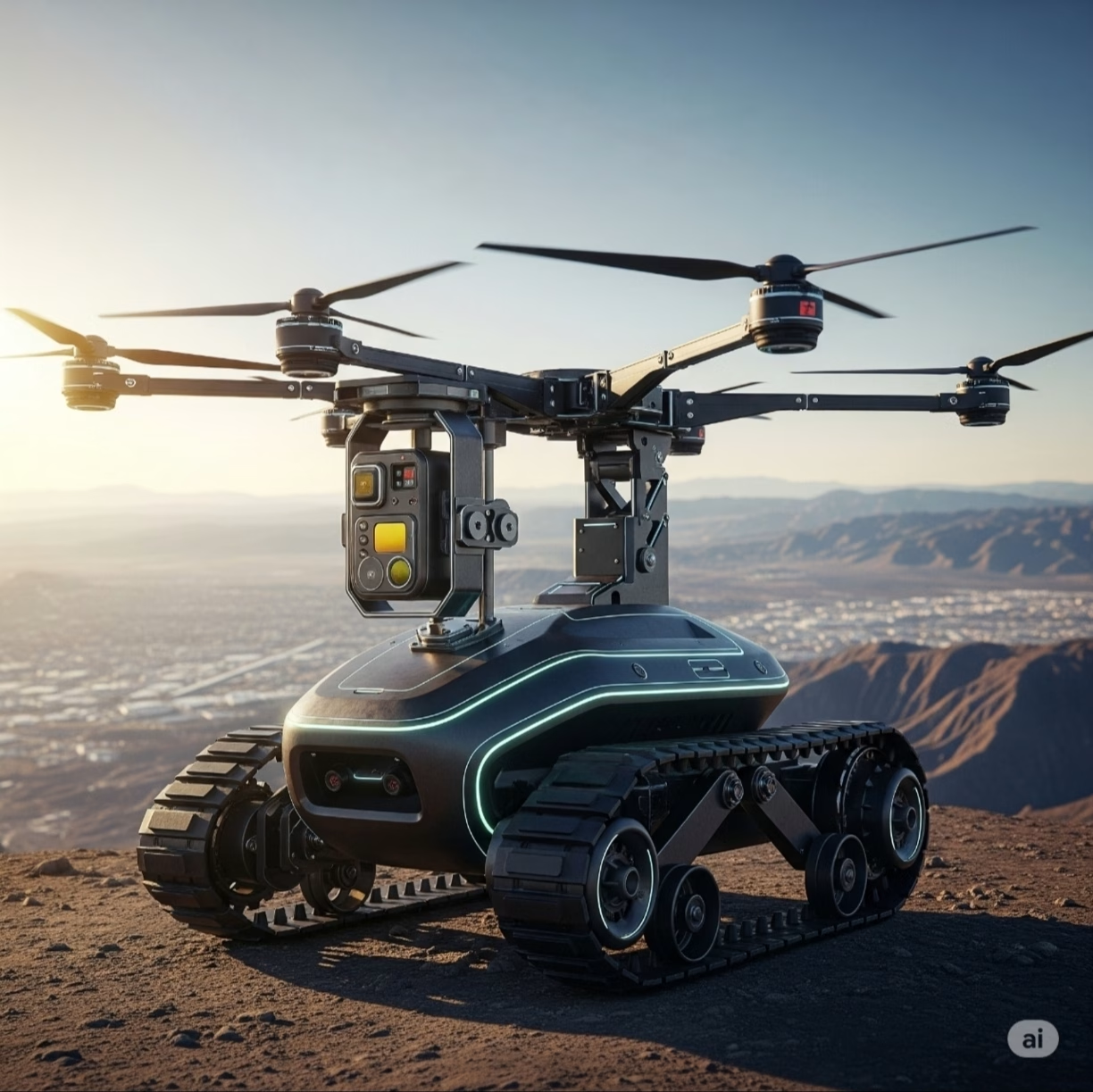
The Hybrid Autonomous Land & Air Surveillance Robot is an ambitious, multi-platform robotics project that merges two worlds:
- A ground rover capable of navigating rough terrains, carrying payloads, and avoiding obstacles.
- An aerial drone capable of flying over obstacles, capturing aerial footage, and scanning large areas quickly.
This system is designed for search & rescue, agricultural monitoring, environmental research, and security patrols — all powered by Arduino, ESP32, and AI-based decision-making..
What is the Hybrid Autonomous Land & Air Surveillance Robot?
Purpose of the Project
The Hybrid Autonomous Land & Air Surveillance Robot is designed to combine the capabilities of a ground rover and an aerial drone into one integrated system.
Its primary goal is to collect data, monitor environments, and execute tasks both on the ground and from the air — making it a highly versatile tool for exploration, safety, and research.
By combining:
- Rover Mode → Navigates obstacles, carries equipment, performs ground-level measurements.
- Drone Mode → Captures aerial footage, maps large areas, and reaches places the rover cannot.
This dual capability reduces mission time, increases coverage, and ensures that if one mode faces limitations, the other can continue the operation.
What Can It Be Used For?
1. Search and Rescue Operations
- Locates survivors in disasters like earthquakes, floods, or fires.
- Uses thermal imaging to detect people or animals trapped under debris or in low-visibility areas.
- Sends GPS coordinates to rescue teams in real-time.
2. Agriculture and Environmental Monitoring
- Conducts crop health analysis using aerial imaging and color analysis.
- Measures soil moisture with ground sensors for smarter irrigation.
- Monitors pest activity and plant growth patterns.
3. Security and Patrol Missions
- Patrols large facilities, warehouses, borders, or open areas.
- Detects unusual activity using AI-based object/person recognition.
- Operates even in total darkness with night vision and thermal cameras.
4. Scientific Research
- Observes wildlife without disturbing natural behavior.
- Detects early signs of forest fires using smoke and temperature sensors.
- Collects environmental data from remote or dangerous locations.
5. Industrial Inspection
- Examines infrastructure like power plants, pipelines, wind turbines, and solar farms.
- Performs both ground-level and aerial inspections for comprehensive reports.
- Reduces the need for human workers in hazardous locations.
💡 In Summary:
This project creates a multi-purpose robotic platform that can take over tasks in exploration, safety, surveillance, and research.
Its ability to function both on land and in the air makes it more flexible and effective than single-mode robots.
Key Features
1. Dual Operation Modes
- Rover Mode: Moves across rugged terrain, avoids obstacles with LIDAR or ultrasonic sensors, and carries tools or payloads.
- Drone Mode: Takes off vertically to perform aerial mapping, surveillance, or environmental scanning.
2. Autonomous Navigation
- GPS + digital compass for location tracking
- IMU sensors for orientation and stability
- LIDAR or ultrasonic modules for obstacle detection
- AI-powered route optimization
3. Advanced Imaging
- ESP32-CAM or Raspberry Pi Camera for live video streaming
- TensorFlow Lite for face/object recognition
- Thermal camera (MLX90640) for night vision or heat detection
- High-resolution mapping for research or security
4. Mission Modes
- Search & Rescue: Detect humans via thermal imaging and GPS-mark their locations.
- Agricultural Monitoring: Scan crops for health, detect moisture levels, and report findings.
- Security Patrol: Identify suspicious activities and send alerts in real-time.
5. Energy Efficiency
- Solar panels for autonomous charging in remote areas
- Battery health monitoring
- Smart power management to extend operational time
6. Remote Control & IoT
- Control via Wi-Fi, LoRa, or 4G
- Real-time location tracking on a mobile or web dashboard
- Live camera feed accessible from anywhere
- MQTT and Node-RED integration for IoT automation
7. Artificial Intelligence Integration
- Classify and identify objects or obstacles
- Prioritize missions based on detected events
- Machine learning models to improve navigation efficiency over time
⚠️ Attention !
Before starting any project implementation, please read the Safety & Legal Disclaimer section at the bottom of this page. It contains important guidelines to ensure safe and responsible usage.
Hardware Components
- Arduino Mega / ESP32 as the main controller
- GPS module (NEO-6M) for positioning
- IMU sensor (MPU6050 or BNO055) for stability
- LIDAR (RPLidar A1) or ultrasonic sensors for obstacle detection
- ESP32-CAM or Raspberry Pi + camera module
- Thermal camera (MLX90640) for heat detection
- Motor drivers for rover control
- Brushless motors + ESC for drone propulsion
- LoRa, Wi-Fi, or 4G communication modules
- Solar panel + battery management system
- LED spotlights & sirens for rescue missions
Software & Technologies
- Arduino IDE / PlatformIO for programming microcontrollers
- MAVLink protocol for drone control
- OpenCV (Python) for image processing
- MQTT for IoT communication
- Node-RED for a customizable web dashboard
- Google Maps API for location tracking
- TensorFlow Lite for AI-based object detection
Potential Applications
- Search & Rescue Operations in disaster zones
- Border Patrol & Security Surveillance
- Environmental Monitoring in remote areas
- Agricultural Field Analysis for crop health
- Wildlife Research without disturbing animals
Project Complexity
This is a highly advanced robotics project that requires:
- Proficiency in Arduino and ESP32 programming
- Knowledge of drone flight systems
- Experience with IoT, GPS, and sensor integration
- Basic AI and image processing skills
It’s recommended to build it module-by-module, starting with the rover, then the drone, and finally integrating AI and IoT functionalities.

Fritzing Diagram — Hybrid Land & Air Surveillance Robot
Summary
This Fritzing project illustrates a ground-rover core wiring that integrates navigation sensors, motor control, a camera module, and peripheral payloads — designed as the primary electronics hub for the Hybrid Autonomous Land & Air Surveillance Robot. The diagram focuses on the rover/edge-controller portion while including the drone interface header (MAVLink telemetry bridge) so the wiring is compatible when switching to drone mode.
The delivered assets include:
- A schematic view showing electrical connections and connectors.
- A breadboard-style assembly image for prototyping clarity.
- A parts list with recommended part names and pinouts.
- A pin-mapping and signal table you can copy into firmware.
Primary Components (as shown in the Fritzing diagram)
- Arduino Mega 2560 (main I/O hub for sensors and motor controllers)
- ESP32-WROOM (secondary controller, Wi‑Fi, MQTT, camera bridge)
- ESP32-CAM (vision streaming, local inference hooks)
- GPS module (NEO-6M) with SMA antenna connector
- IMU (MPU6050/BNO055) on the I2C bus
- HC-SR04 ultrasonic sensor (front obstacle sensing)
- Motor driver (TB6612 or L298N) for rover DC motors
- DC gearbox motors (2 or 4-wheel drive)
- 4-channel relay module (payload switching: lights, siren, pump)
- Power distribution (XT60 input, DC-DC 12V→5V regulator)
- MAVLink header (TTL serial lines for Pixhawk / flight controller integration)
Wiring Overview
Power rails:
- The main battery (XT60) feeds a primary switch and a fuse, then splits to:
- Motor supply (direct to motor driver VIN) — this may be the raw battery voltage (e.g., 12V).
- Digital supply through a DC-DC regulator (5V) to power Arduino Mega, ESP32, sensors, relays.
- Common ground: All modules share a single common ground bus.
Signal wiring highlights:
- GPS: connected to
Serial1on the Mega (TX1 / RX1) so GPS NMEA sentences are read on a dedicated UART. - IMU: wired to the I2C pins (SDA -> 20, SCL -> 21 on Mega wiring note or to the ESP32 I2C if preferred). Pull-up resistors included on bus.
- HC-SR04: Trigger -> digital output pin, Echo -> digital input with 5V→3.3V safe divider if measured by 3.3V logic.
- Motor driver: PWM inputs wired to Mega PWM-capable pins; enable pins tied to a safe shutdown GPIO that kills motor driver PWM when needed.
- Relays: Driven from Mega digital outputs via transistor drivers (or relay module opto-coupled inputs), with flyback diode protection for inductive loads.
- ESP32 / ESP32-CAM: ESP32 is connected over Serial or I2C for telemetry + OTA updates; ESP32-CAM uses its own power rail (stabilized 5V → VIN) and a UART line for command/trigger.
- MAVLink header: TTL TX/RX and +5V/GND lines exposed on a 6-pin header for quick connection to Pixhawk telemetry port.
Pin Mapping Table (copy into firmware)
Component        | Microcontroller  | Pin
-----------------|------------------|-----------------
GPS (TX->RX1)    | Mega Serial1 RX  | RX1 (19)
GPS (RX->TX1)    | Mega Serial1 TX  | TX1 (18)
IMU SDA          | I2C SDA          | SDA (20)
IMU SCL          | I2C SCL          | SCL (21)
HC-SR04 TRIG     | Digital Out      | D22
HC-SR04 ECHO     | Digital In       | D23
Motor PWM L      | PWM              | D2 (OC3A)
Motor PWM R      | PWM              | D3 (OC3B)
Motor EN         | Digital Out      | D24
Relay 1          | Digital Out      | D25
Relay 2          | Digital Out      | D26
ESP32 Serial RX  | Serial (to ESP)  | D14 (UART3 RX)
ESP32 Serial TX  | Serial (to ESP)  | D15 (UART3 TX)
MAVLink TX       | TTL TX           | D16
MAVLink RX       | TTL RX           | D17
Note: Pin numbers are listed with Arduino Mega conventions. If you move to ESP32-native control, remap pins accordingly and keep I2C/SPI pins consistent.
Breadboard & Connector Conventions
- Color coding in the Fritzing diagram follows: Red = V+, Black = GND, Yellow/Orange = signal lines, Green = UART Rx/Tx, Blue = I2C.
- Connectors used: XT60 for battery input; JST-SR for sensor clusters; 2.54mm female headers for serial and MAVLink bridging.
- Fuse recommendations: 30A automotive fuse on battery positive for the rover bank; separate smaller fuses (5A) for logic/regulator output.
Safety Notes
- Remove power when assembling and re-check polarity before connecting battery.
- Verify regulator heat dissipation: DC-DC converters should have adequate cooling and capacitors per datasheet.
- Common ground required: Ensure all grounds are star-connected near the main regulator to avoid noisy motor currents interfering with sensors.
- Isolate high-current traces: Motor currents should not run through the Arduino ground pins; use a heavy gauge bus bar for motor ground return.
- Add emergency STOP: A physical kill-switch on the main battery feed and an electronic STOP line to disable motor PWM from software.
Quick Test Checklist (after wiring)
- Measure and confirm 5V rail with multimeter (no load).
- Power the Mega alone (disconnect motors) and check USB serial for boot messages.
- Confirm GPS NMEA sentences arriving at Serial1.
- Run a simple I2C scanner sketch to detect IMU.
- Verify motor driver enable/disable toggles without spinning motors connected.
- Check relay activation (use a safe low-voltage dummy load first).
How this Fritzing ties into the Hybrid System
- The diagram is intentionally rover-centric but includes a MAVLink serial header so the same electronics hub can hand off high-level commands to a flight controller when switching to drone operation.
- Vision (ESP32-CAM) is connected for local streaming and edge detection; heavier inference can be routed to an onboard Raspberry Pi if available (not shown in this basic wiring to keep wiring simple).

Hybrid Ground–Air Robot System – Fritzing Schematic Explanation
This Fritzing diagram represents the full wiring layout for a hybrid robotic system that can operate both on land (as a rover) and in the air (as a drone). The design integrates multiple sensors, cameras, motor drivers, and ESCs (Electronic Speed Controllers) to control both DC motors for ground movement and brushless motors for aerial flight.
1. Core Controller
- Arduino Mega 2560
- Serves as the main control unit.
- Manages data acquisition from sensors and controls actuators for both ground and aerial operations.
- Selected for its high number of digital/analog pins and sufficient memory for complex control logic.
2. Sensors
- GPS Module
- Provides global positioning for navigation and autonomous route planning.
- IMU (Inertial Measurement Unit)
- Measures acceleration, orientation, and angular velocity.
- Essential for stabilizing the drone in flight and monitoring rover tilt.
- Ultrasonic Distance Sensor
- Detects nearby obstacles.
- Used for collision avoidance in rover mode and low-altitude landing assistance in drone mode.
3. Vision System
- ESP32-CAM Module
- Captures real-time video and images.
- Can be streamed over Wi-Fi for FPV (First-Person View) piloting or image recognition tasks.
4. Ground Mobility
- DC Motors with Motor Driver Module
- Two geared DC motors for rover movement.
- Motor driver handles speed control and direction switching.
5. Aerial Mobility
- Brushless Motors with ESCs
- Four BLDC motors for quadcopter-style lift.
- ESCs translate Arduino’s PWM control signals into 3-phase power for the motors.
6. Auxiliary Control
- Relay Module
- Controls high-current accessories (LED lights, pumps, payload systems).
- Electrically isolates Arduino from high-voltage circuits.
7. Power System
- LiPo Battery Pack
- Powers all electronics and motors.
- Voltage regulated to 5V for logic circuits and higher voltage supplied directly to motors/ESCs.
8. Functional Overview
- In Rover Mode:
- DC motors are activated via the motor driver.
- GPS + ultrasonic sensors enable autonomous navigation.
- Camera streams video for remote control.
- In Drone Mode:
- Brushless motors provide lift via ESCs.
- IMU and GPS data stabilize and navigate flight.
- Camera enables FPV piloting.
- Shared Systems:
- Relay module controls optional add-ons in either mode.
- Power distribution ensures motors and logic run efficiently.
9. Real-World Applications
- Search and rescue operations in rough terrain.
- Surveillance and inspection of large areas.
- Delivery of small payloads to hard-to-reach locations.
- Educational robotics for teaching multi-modal control systems.
Final Thoughts
Robot movement isn’t just about wheels and legs – it’s a combination of sensors, intelligence, and lots of trial-and-error. Whether you’re just starting or building a robot for research, learning how motion works is key to everything in robotics.
Share your thoughts in the comments and join the discussion on ROBOFORUM – the community for future-minded thinkers in robotics and AI!
Leave a comment and join the discussion. If you’re not already subscribed, please subscribe or log in.
⚠️ Safety & Legal Disclaimer
These projects arefor educational, prototyping, andideation purposesonly.These systems, developed usingAI logic, should becarefully testedbefore being implemented in the real world, and the accuracy of the electronic devices and connections usedshould be double-checked.All actions, implementations, and outcomes resulting from this project are entirely the responsibility of the developer or individual applying the system.For real-life deployment, the system must be equipped with proper sensors, protective housings, safety mechanisms, and comply with local legal regulations.Any misuse or misinterpretation of the project that results in device damage, data loss, or accidental injury is entirely the user’s responsibility.Always use the projectresponsiblyand perform thoroughextensive testingbefore live use or field deployment.
⚠️ Supervision & Controls
Especially for users with limited electronics experience, including children, it is strongly advised to work under the constant supervision of an experienced adult or professional when assembling or testing such projects.