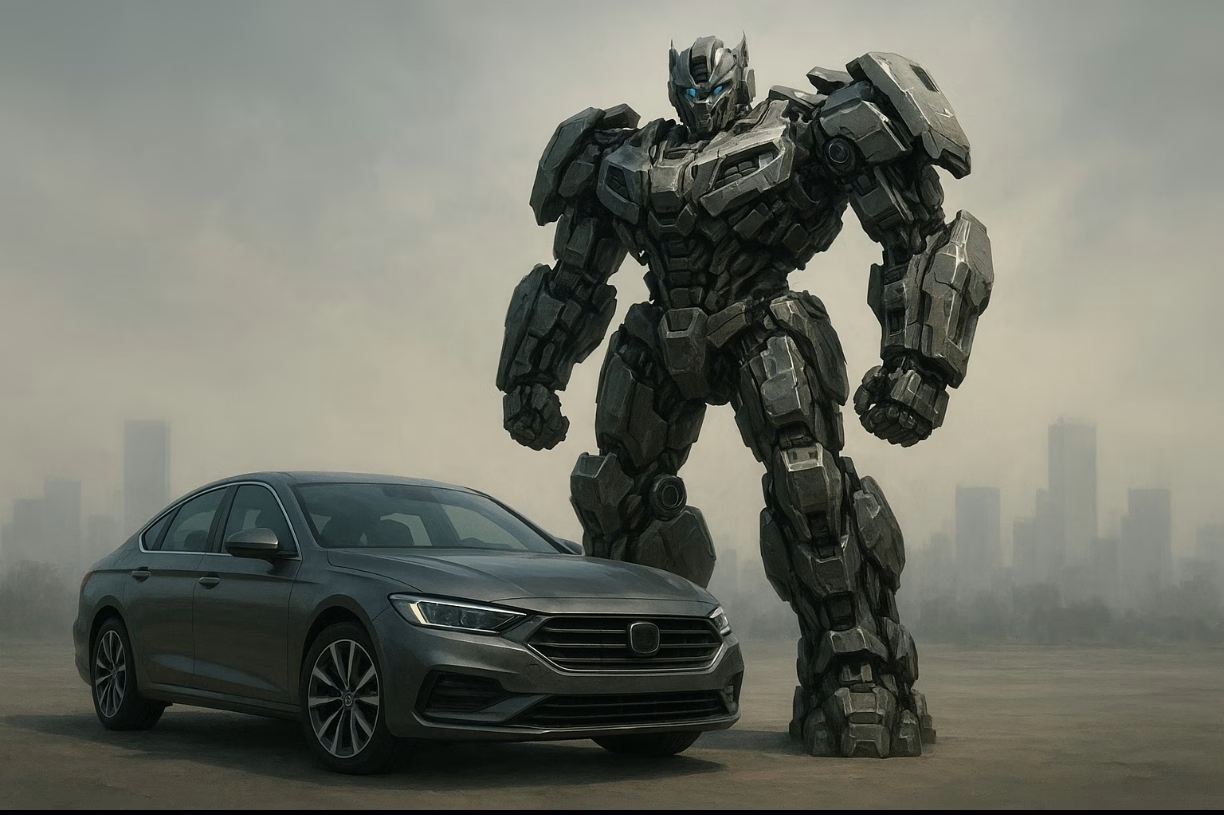
A Deep Dive into Fiction, Robotics, and the Future of Machines
Introduction
When people hear the word Transformers, most immediately think of the famous Hollywood movies and toys—giant robots that can disguise themselves as cars, planes, or even everyday objects. But an important question arises: Are Transformers robots real, or are they only science fiction? This article explores the line between fantasy and reality in robotics, and examines whether technology could one day make Transformers a reality.
The Origins of Transformers
Transformers were first introduced as toys and animated characters in the 1980s. They became cultural icons, representing advanced mechanical beings with intelligence, emotions, and the extraordinary ability to transform their physical bodies into vehicles or machines. While these are purely fictional, they inspired many engineers, scientists, and roboticists to push the boundaries of what real robots can do.
Current Robotics vs. Transformers
Modern robotics has made incredible progress, but there are still huge differences between real robots and fictional Transformers.
- Shape-Shifting Ability
- In Transformers, robots change from cars into humanoids instantly.
- In reality, researchers have developed modular robots that can reconfigure themselves, but the process is slow, limited, and far from Hollywood-style transformations.
- Artificial Intelligence
- Transformers have personalities, emotions, and advanced reasoning.
- Real AI can analyze data, recognize speech, and even generate creative content, but it does not yet possess true consciousness or emotions.
- Size and Power
- Transformers are massive, often several stories tall.
- Real robots are generally smaller, and large humanoid robots (like Atlas from Boston Dynamics) still struggle with energy consumption, balance, and mobility.
Real-World Projects Inspired by Transformers
Although we do not have giant transforming Autobots or Decepticons, there are real innovations that reflect elements of the Transformers fantasy:
- Shape-Changing Materials: Scientists are developing materials that can change form when exposed to heat, electricity, or magnetic fields.
- Military and Rescue Robots: Some experimental machines can fold into compact forms and expand when needed, much like miniature Transformers.
- Car-Robot Hybrids: Engineers in Japan and Turkey have built demonstration vehicles that can stand up and transform into a humanoid robot. These projects are still in prototype stages, but they show the influence of the Transformers concept.
Could Transformers Become Real in the Future?
Technologically speaking, building a real Transformer would require:
- Advanced modular engineering (flexible joints, folding parts).
- Immense energy sources to power both vehicle and humanoid modes.
- Highly sophisticated AI for decision-making and adaptation.
While we are far from achieving this, it is not impossible to imagine that in the next 50–100 years, science could produce machines that resemble primitive versions of Transformers. However, the cinematic scale—giant robots fighting in cities—remains mostly in the realm of fiction.
Conclusion
So, are Transformers robots real? The simple answer is no—at least not in the way movies portray them. But the dream of shape-shifting robots has already influenced real-world engineering. Today’s robotics field is slowly moving toward machines that can adapt their shapes, learn, and perform tasks dynamically. In short, Transformers may not exist yet, but they continue to inspire the future of robotics.
✨ Do you believe real Transformers will exist one day? Share your thoughts and join the discussion on our website!