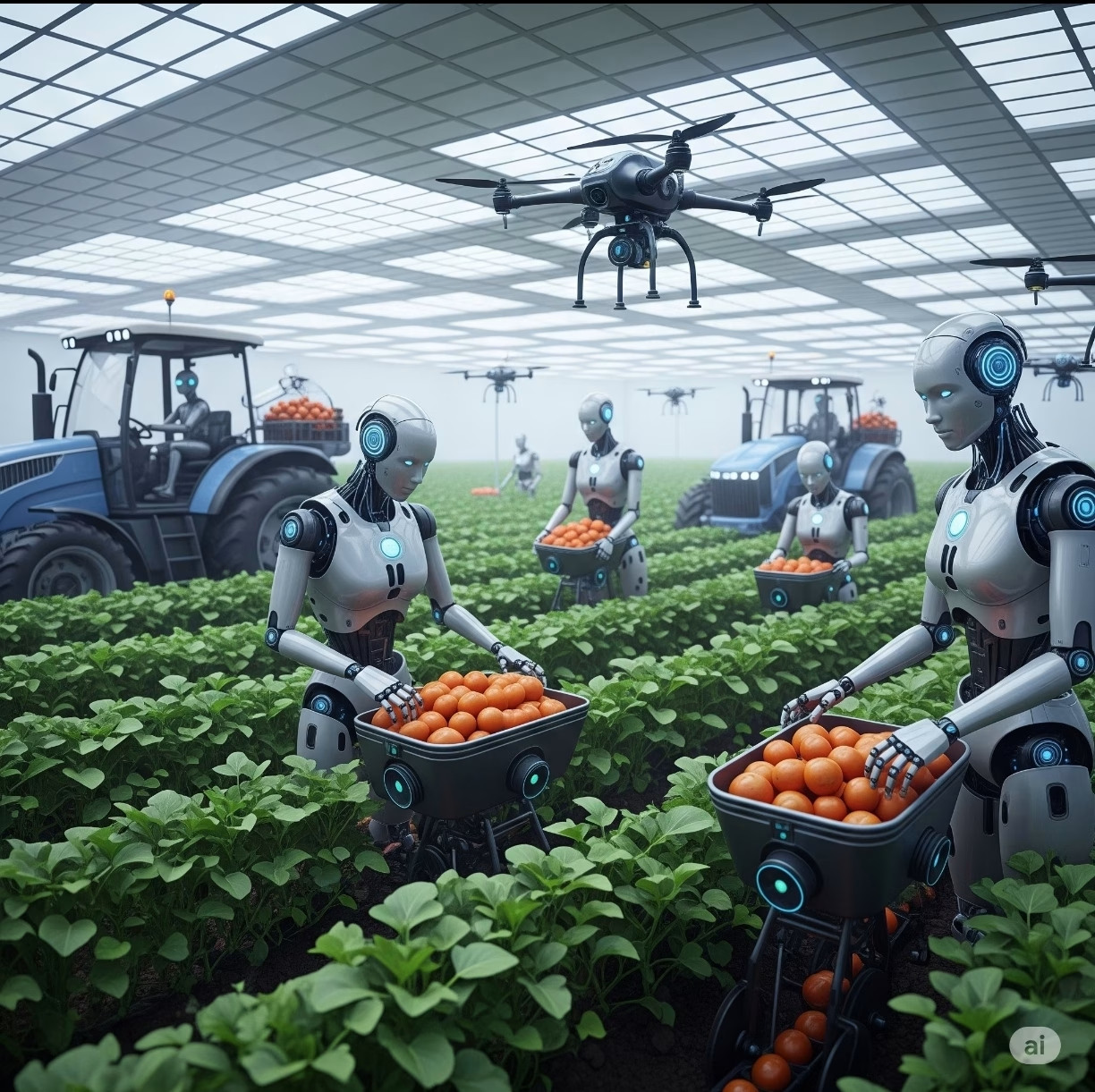
Object detection and grasping in robots is a fundamental capability for robotic manipulation and automation. This involves the robot’s ability to perceive objects in its environment, recognize and locate them, and then plan and execute the grasping of those objects with precision. Here’s an overview of the key components and techniques involved in object detection and grasping for robots:
Object Detection:
- Sensors: Robots typically use a combination of sensors to detect objects. Common sensors include cameras, depth sensors (e.g., LiDAR or depth cameras), and tactile sensors. These sensors provide data about the objects’ position, size, shape, and other relevant features.
- Computer Vision: Computer vision algorithms are crucial for processing data from cameras and other vision sensors. Techniques like image processing, feature extraction, and object recognition are used to identify objects in the robot’s field of view.
- Machine Learning: Machine learning, particularly deep learning, has significantly improved object detection accuracy. Convolutional Neural Networks (CNNs) are commonly used for tasks like object recognition and segmentation.
- Point Cloud Processing: In the case of 3D sensors, point cloud processing is employed to extract information about the 3D geometry of objects. This data is valuable for grasping and manipulation planning.
- Object Tracking: For dynamic environments, object tracking algorithms help the robot maintain awareness of the objects’ positions as they move.
Grasping:
- Grasping Algorithms: Grasping algorithms determine how the robot’s end effector (e.g., gripper) should approach and manipulate an object. This involves selecting a grasp point and planning the motion to achieve the grasp.
- Grasping Strategies: Different grasping strategies can be used, such as power grasp, pinch grasp, or precision grasp, depending on the object’s shape and size. The choice of strategy can be based on the object’s characteristics.
- Force and Compliance Control: To avoid damaging objects or dropping them, robots may employ force and compliance control techniques. This allows them to adjust the grip force and maintain a secure hold on the object.
- Simulation and Planning: Many robots use simulation and motion planning to simulate and optimize grasping strategies before executing them in the real world. This reduces the risk of failure and increases efficiency.
- Learning-Based Grasping: Some robots use reinforcement learning or imitation learning to improve their grasping skills over time. This can be particularly valuable when dealing with diverse object shapes.
Integration:
- Sensor Fusion: Robots often combine data from multiple sensors to get a more comprehensive understanding of the environment and objects. This can enhance object detection and grasping accuracy.
- Robot Control: The object detection and grasping system should integrate with the robot’s overall control system, allowing it to execute the grasping plan based on the detected objects.
- Feedback: Feedback from the grasping process is crucial. If the robot encounters difficulty or makes errors during grasping, it should be able to adapt and adjust its approach.
Object detection and grasping can be quite complex, especially in unstructured environments with a variety of objects. The state-of-the-art in this field is constantly advancing, with ongoing research in computer vision, machine learning, and robotic manipulation to improve the capabilities of robots for tasks such as picking and placing objects in industrial settings or assisting with everyday tasks in human environments.
Developing a complete object detection and grasping system for a robot is a complex task, and the specific code would depend on the robot’s hardware, sensors, and gripper design. Below, I’ll provide a simplified example using Python and some common libraries for object detection and grasping. This example assumes you have a robot with a camera and a simple parallel gripper.
Please note that this is a simplified example, and in a real-world application, you would need to tailor the code to your specific robot and environment. You would also need to use specialized libraries and hardware for better performance and reliability.
import cv2
import numpy as np
import urx # Universal Robots library
import time
# Initialize the robot
robot = urx.Robot(“192.168.0.2”) # Replace with your robot’s IP address
# Initialize the camera (you may need to install OpenCV)
cap = cv2.VideoCapture(0)
while True:
# Capture a frame from the camera
ret, frame = cap.read()
# Object detection (you’ll need a trained model, e.g., YOLO, SSD)
# This is a simplified example without a real object detection model
# You should replace this with an actual object detection model.
# detected_objects = detect_objects(frame)
# Assuming detected_objects is a list of detected objects with coordinates
if detected_objects:
for obj in detected_objects:
x, y, width, height = obj
# Center of the object
obj_center_x = x + width / 2
obj_center_y = y + height / 2
# Grasping logic (simplified)
# You need to adapt this based on your gripper design and robot
if obj_center_x < 300:
robot.movej([-np.pi / 2, -np.pi / 2, np.pi / 2, -np.pi / 2, -np.pi / 2, 0], acc=0.1, vel=0.1)
robot.movel_tool((0.1, 0, 0, 0, 0, 0), acc=0.1, vel=0.1)
# Close the gripper
robot.set_digital_out(0, True)
time.sleep(2) # Time to grasp the object
# Open the gripper
robot.set_digital_out(0, False)
# Move to a safe position
robot.movej([0, -np.pi / 2, np.pi / 2, -np.pi / 2, -np.pi / 2, 0], acc=0.1, vel=0.1)
# Display the camera feed
cv2.imshow(“Object Detection”, frame)
if cv2.waitKey(1) & 0xFF == ord(‘q’):
break
# Release the camera and close the robot connection
cap.release()
cv2.destroyAllWindows()
robot.close()
In this example, we assume that the robot is a Universal Robots UR robot and that you have a camera to capture images. Object detection is a simplified concept here, and you should replace it with a real object detection model like YOLO or SSD for accurate results. The grasping logic is also simplified and would need to be adapted based on your specific gripper and robot configuration.
Please note that developing a complete object detection and grasping system for a robot typically involves more sophisticated control, motion planning, and integration with specialized libraries and hardware. It’s essential to consult the documentation and resources specific to your robot and sensors for a more comprehensive implementation.