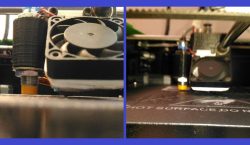

3D printing and/or layered printing is the process of printing three-dimensional solid objects on a 3-D printer with a drawing obtained from a digitally created file.
In fact, the creation of a 3D printed object is achieved by printing layer by layer. For example, in a layered operation, successive layers of material are placed until the object is created, thus creating a physical object. So each of these layers actually creates a thinly sliced section of the object. We can interpret 3D printing as the opposite of a milling machine cutting metal or plastic parts and revealing objects. With 3D printing, it is possible to produce complex materials by using less material and without any waste compared to the production methods carried out with traditional cutting.
How 3D Printing Works

In fact, the beginning of the process here begins with the drawing of the 3D objects to be produced on the computer. So everything starts with a three-dimensional model. In fact, you can also choose to download a 3D version of an existing object from the library while creating a new one. There are many different software tools available for 3D rendered objects.
Tinkercad is generally recommended for beginners here. Tinkercad app is free and also easy to use. It works directly in the web browser and there is no need to install applications. Tinkercad offers easy and learnable beginner lessons for beginners. It also has a built-in export of the 3D model you have made as a printable file, eg. These are, for example, STL or .OBJ extensions. If you have created a model so far and obtained STL or .OBJ extensions, you now have a printable file.
The next step is to prepare it for 3D printing. This process is called slicing. So slicing, slicing from printable file to 3D printer; It means splitting a 3D model into hundreds or thousands of layers. These operations are possible with slicing applications. The next step is if we have sliced our file, this model is ready for our 3D printer.
Uploading the file to the printer is usually possible via USB, SD or Wi-Fi protocols. The sliced file for the model we uploaded to the printer is now ready to be printed on the 3D printer, layer by layer. Since 3D printing is easier and more practical in the 3D printing industry, this type of application has been adopted in the market for the production of objects. For companies that have not yet integrated additive production in the production sector, such an application is among the indispensables of production. Where 3D printing was initially suitable for one-off productions for prototypes and models in the early stages, it is now rapidly turning into a production line technology. Most of the current 3D printing demand consists of industrial products. In the future, it will be possible to expect 3D printing technology to transform into a large industry area and positively change our expectations in our living and working spaces and even in the entertainment sector.
Print Samples in 3D Printing
Since the productions in 3D printing are used in almost all areas that we can think of, the use here covers many technology methods and material forms.
It’s important that we view 3D Printing as a diverse cluster of industries with actually countless different applications.
To give a few examples of these;
From consumer products; Watches, glasses, jewelry design, accessories and furniture
From industrial products; Engine parts, vehicle accessories and model making tools, part prototypes, vehicle model parts
From dental products; prosthesis
Architectural products; scale architectural models, house mock-ups and city project prototypes