Exploring the Limits of Mechanical Endurance and Digital Fatigue
In a world where robots are working around the clock—delivering packages, assembling cars, patrolling malls—it’s natural to wonder:
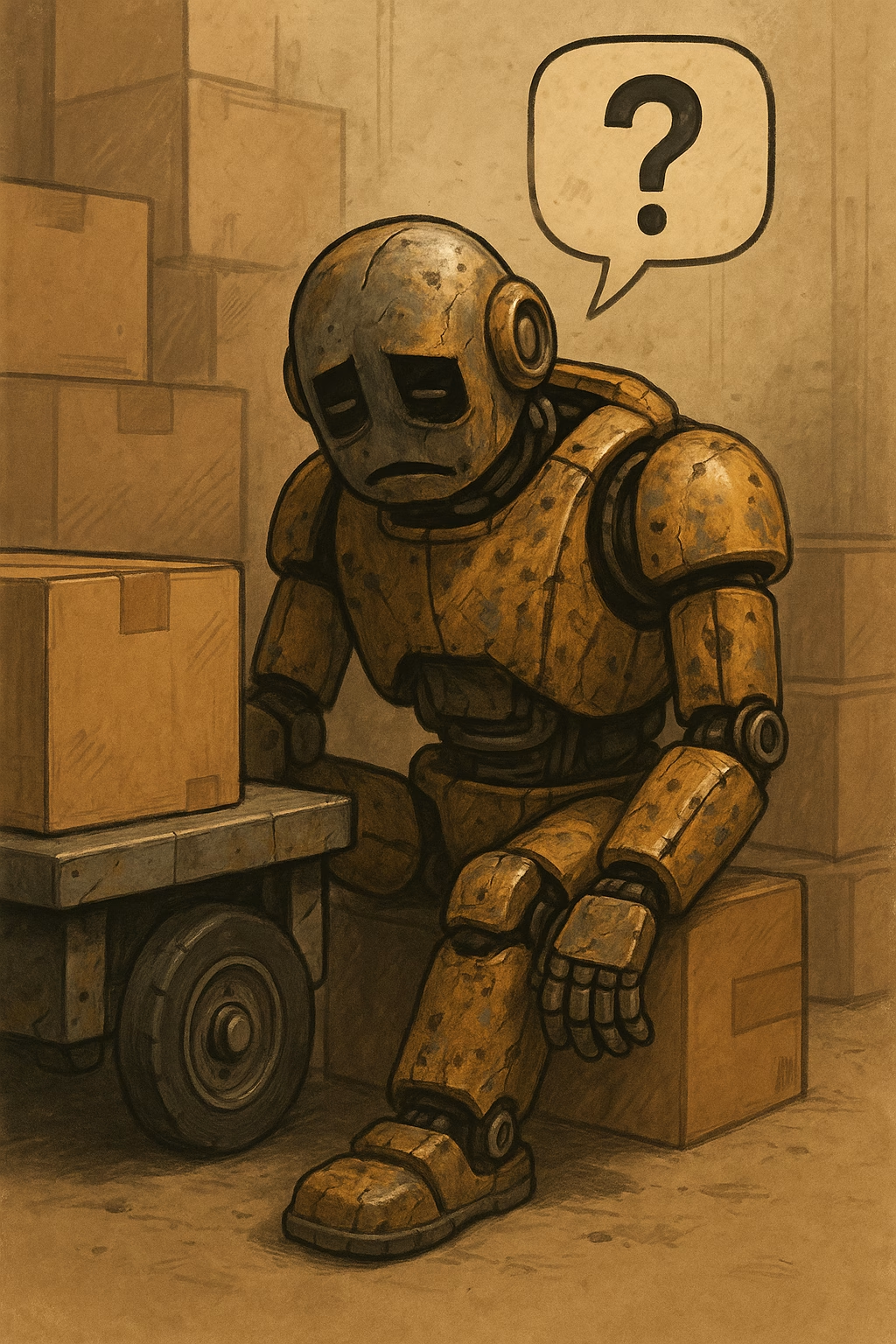
Can robots suffer from burnout like humans do?
The short answer is: Yes, but not the way you might think.
Let’s break it down.
⚙️ 1. Physical Burnout: When Hardware Hits the Wall
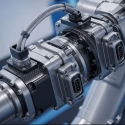
Robots are made of motors, actuators, gears, and batteries—all of which wear down over time. In high-stress environments like warehouses or factories, these components can overheat, lose precision, or even fail entirely.
- 🔋 Battery degradation from continuous operation
- 🔧 Gear and motor wear due to repetitive heavy lifting
- 🌡️ Thermal fatigue under hot conditions
🛠️ A delivery robot used for 20 hours a day with minimal charging breaks may overheat or suffer power drops, leading to shutdown.
🧠 2. Software Burnout: When Code Breaks Down
Burnout isn’t just physical—software failures can cripple robots too.
Some common causes:
- 🧮 Memory leaks that slow the system over time
- 🔄 Infinite loops in task logic
- 🧩 Sensor overload due to complex or noisy environments
- 🖥️ CPU overload during heavy processing
A robot overloaded with tasks or sensor input may freeze, reboot, or malfunction unexpectedly.
👁️ 3. Sensor Confusion: When the Eyes Deceive the Brain
Robots rely on sensors like LiDAR, cameras, sonar, and accelerometers to perceive the world. In harsh or dynamic environments:
- Blinding lights
- Reflective surfaces
- Dust or fog
- Signal interference
…can confuse the robot’s decision-making and cause erratic behavior, like crashing into objects or falling down stairs.
📰 In a real-life incident, an Amazon robot misread its environment and tumbled down a stairwell—leading social media to call it a “robot burnout.”
❌ 4. No Emotions: Robots Don’t Feel Stress (Yet)
Robots do not have emotions, consciousness, or psychological stress. They cannot “feel tired” or “give up.”
However, people often anthropomorphize robots, assigning human-like interpretations to their failures:
“The robot collapsed—it must be exhausted!”
“It jumped into the pool… was it depressed?”
These stories are humorous but ultimately symbolic.
🔮 5. Will Conscious Robots Burn Out in the Future?
As AI advances toward autonomy and emotional modeling, future robots might:
- Evaluate their own workload
- Choose to rest or ask for help
- Simulate emotional responses to pressure
But for now, burnout in robots remains a mechanical and algorithmic issue, not an emotional one.
🧾 Real Incidents of Robot “Burnout”
| 🤖 Robot | 🔥 Burnout Type | 📝 What Happened |
|---|---|---|
| Amazon Warehouse Bot | Sensor/Navigation Error | Fell down stairs after misreading floor edge |
| Knightscope K5 | Misjudged Terrain | Rolled into a fountain at a mall |
| Boston Dynamics Spot | Battery Overuse | Shut down after long operational stress |
| Autonomous Drone | Overheated Chipset | Mid-flight failure due to CPU overload |
💡 Conclusion: Yes, Robots Can Burn Out — But Not Like Us
While robots don’t get emotionally drained, they do fail from:
- Physical wear
- Software bugs
- Environmental confusion
It’s not emotional burnout—it’s engineering failure. But with continued development in AI and machine ethics, who knows what future “robot fatigue” might look like?
🤔 What do you think? Will future robots demand vacation days?
💬 Leave a comment below and join the discussion!
🔐 Sign in to unlock more robot ethics and AI articles!
👉 Share your thoughts in the comments and join the discussion on ROBOFORUM – the community for future-minded thinkers in robotics and AI!
👇 Leave a comment and join the discussion. If you’re not already subscribed, please subscribe or log in