Understanding How Robots Learn and Adapt
🔍 What Is AI Training in Robotics?
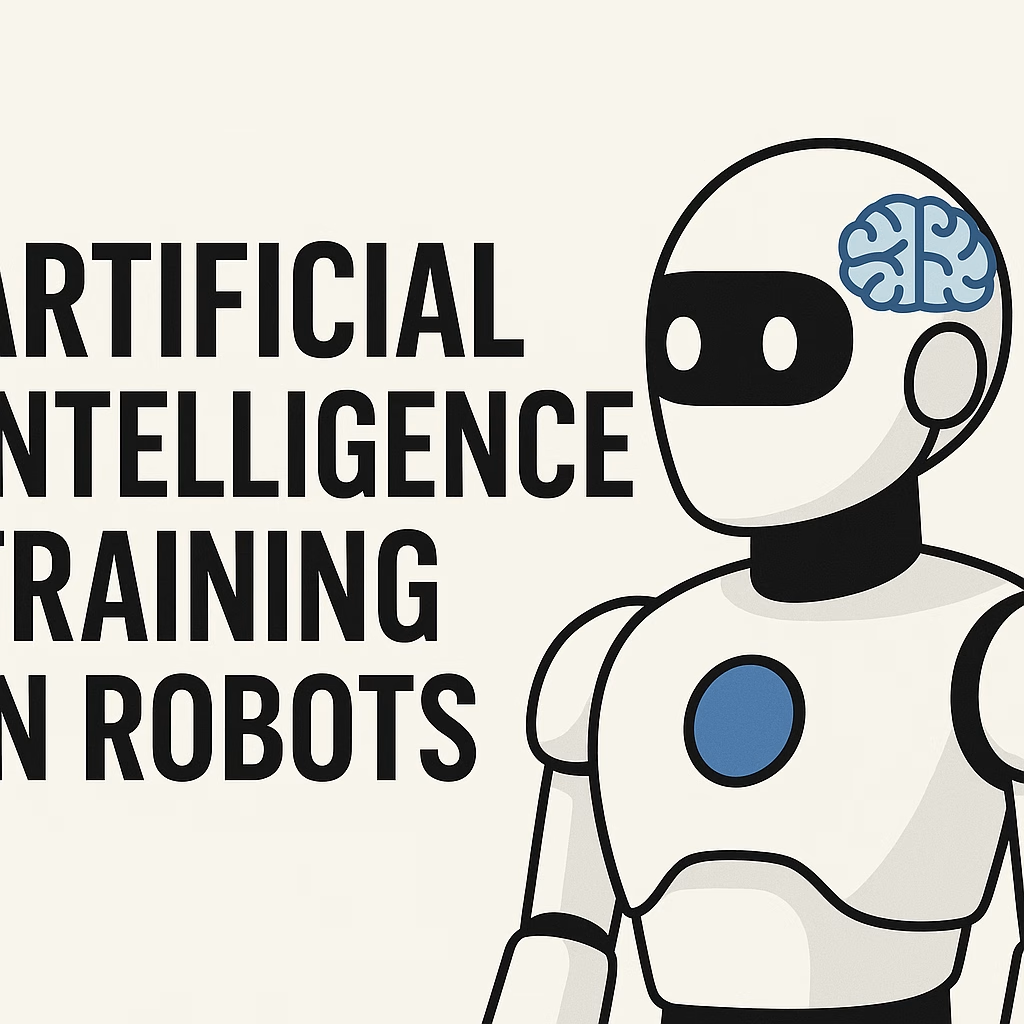
Artificial Intelligence (AI) training in robotics refers to the process of teaching robots how to interpret data, make decisions, and improve performance over time. Unlike traditional robots that follow pre-programmed commands, AI-powered robots can learn from experience and adapt to dynamic environments.
🧠 Key AI Techniques Used in Robotics
1. Supervised Learning
- Robots are trained using labeled datasets (input-output pairs).
- Example: A robot is shown thousands of images of objects labeled as “apple,” “cup,” “pen,” etc. It learns to recognize these objects.
2. Reinforcement Learning (RL)
- Robots learn by interacting with their environment.
- They receive rewards or penalties and adjust actions to maximize total rewards.
- Used in walking robots, robotic arms, and games.
3. Unsupervised Learning
- Robots find patterns in unlabeled data.
- Helpful in clustering and anomaly detection, like identifying faulty parts on an assembly line.
4. Deep Learning
- Uses deep neural networks to process complex inputs like vision, speech, or sensor data.
- Example: Self-driving delivery robots that analyze street traffic.
🛠️ Common Applications of AI in Robots
| Application | AI Role |
|---|---|
| Autonomous Vehicles | Path planning, obstacle avoidance, and object recognition |
| Industrial Robots | Quality inspection, predictive maintenance |
| Healthcare Robots | Patient monitoring, medication reminders |
| Social Robots | Human interaction, emotional detection |
| Service Robots | Cleaning, delivery, and receptionist tasks |
🎓 How Are Robots Trained?
🏗️ Step-by-Step Training Process:
- Define the Goal
(e.g., “Pick and place an object on a shelf”) - Collect Data
Sensors, cameras, or simulations gather data from the environment. - Choose AI Model
Select an algorithm (e.g., CNN for vision, Q-learning for RL). - Train the Model
Use computing resources (PC, cloud, or onboard GPU). - Test and Validate
Ensure accuracy in real-world scenarios. - Deploy and Fine-Tune
Implement updates as the robot gains more experience.
🧪 Tools and Frameworks Used in AI Robotics
| Tool/Platform | Purpose |
|---|---|
| TensorFlow | Deep learning models |
| PyTorch | Flexible training experiments |
| ROS (Robot OS) | Robotics middleware |
| OpenAI Gym | Simulation environments for RL |
| Gazebo | 3D robotic simulation |
🤔 Why Is AI Important in Robotics?
AI allows robots to:
- Adapt to new environments
- Learn from mistakes
- Improve task performance over time
- Interact naturally with humans
- Solve complex problems without explicit programming
🔮 The Future of AI in Robots
AI will drive the next generation of autonomous, intelligent, and emotionally aware robots. With the rise of edge computing and real-time training, robots will become more responsive and human-like.
📌 Conclusion
AI training in robotics is transforming how machines operate—from static executors to dynamic, learning agents. Whether it’s a robotic vacuum or a humanoid assistant, AI gives robots the power to evolve with each experience.
🌐 Want More Projects Like This?
🔥 Comment your ideas & share your results!
📥 Log in to explore full project guides:
👇 Leave a comment and join the discussion. If you’re not already subscribed, please subscribe or log in
#AIinRobotics #MachineLearning #SmartRobots #FutureOfWork