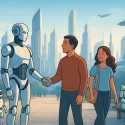
🚀 A New Era of Human-Robot Collaboration Is Coming
From factories to hospitals, and from farms to the frontlines of space exploration, robots are no longer just science fiction—they are becoming a central part of our daily lives. In the coming decades, robotic technology is expected to transform how we live, work, learn, and even heal.
Let’s explore how robots are set to reshape human society, solve global challenges, and enhance quality of life in unimaginable ways.
🌱 1. Agriculture & Food Security
🚜 Smart Farming Robots
- Robots will help automate planting, watering, and harvesting, ensuring food is produced more efficiently and sustainably.
- Drones and autonomous machines will monitor soil conditions, predict diseases, and optimize crop yields.
🍎 Global Impact
- Helps solve world hunger by increasing food output with less land and labor.
- Reduces chemical use through precision agriculture.
🏥 2. Healthcare & Elderly Care
🏥 Surgical & Diagnostic Robots
- Precision robots like Da Vinci Surgical System assist doctors in complex operations.
- AI-powered robots can detect diseases early through image and data analysis.
🧓 Companion & Care Robots
- In aging societies, robots will offer companionship, medication reminders, and physical assistance.
- Example: PARO, a therapeutic seal robot for dementia patients.
💉 Pandemic Response
- During COVID-19, robots were used for disinfection, delivery, and even remote temperature screening.
🏠 3. Smart Homes & Daily Living
🧹 Domestic Robots
- Think beyond vacuum cleaners — future home robots will handle cooking, cleaning, laundry, and caregiving.
- Personalized assistants powered by AI will help schedule your day, manage your health, and even engage in conversation.
👨👩👧👦 Social Impact
- Enables independence for people with disabilities.
- Frees up time for human connection and creativity.
🏗️ 4. Industry & Workforce Transformation
⚙️ Automation in Manufacturing
- Robots are already revolutionizing factories with speed, precision, and 24/7 work capacity.
- AI allows them to adapt to custom tasks, making “smart factories” more flexible.
📦 Logistics & Delivery
- Warehouse robots (like those at Amazon) streamline inventory handling.
- Delivery robots and drones will soon bring packages right to your doorstep.
📉 Will Robots Take Our Jobs?
- Yes and no. Some jobs will be replaced, but new ones will emerge: robotics engineers, AI ethicists, robot therapists, etc.
- The key is reskilling and human-robot collaboration.
🌍 5. Environment & Sustainability
♻️ Environmental Monitoring
- Robots will patrol forests, oceans, and skies to detect pollution, track climate data, and protect endangered species.
🧽 Eco-Robots
- Swarm robots that clean up ocean plastics.
- Autonomous drones that plant trees in deforested areas.
🔋 Energy Efficiency
- Robots powered by renewable energy can operate in remote or hazardous environments without human risk.
🚀 6. Space & Exploration
🌕 Robots in Space
- NASA’s Perseverance rover on Mars, and upcoming humanoid robots, are exploring space where humans can’t.
- In the future, robots will help build habitats on the Moon and Mars, or assist astronauts with tasks.
🌌 The Final Frontier
- Robots will be essential in preparing the way for human colonization of other planets.
🧠 7. Education & Creativity
🧑🏫 Robotic Tutors
- AI-based tutors can offer personalized learning, help students with disabilities, and bring STEM education to remote areas.
🎨 Creative Companions
- Robots like Ai-Da, the painting robot, show how machines can participate in art, design, and music.
- Assist creators in brainstorming, drafting, and producing content faster.
⚖️ 8. Ethics & Human-Robot Relations
🧩 Challenges We Must Face
- Privacy and surveillance concerns.
- Risk of over-dependence on machines.
- Ensuring fair access and preventing robot misuse (e.g., in warfare).
🧠 Emotional Intelligence
- Robots with emotional recognition will impact therapy, education, and customer service.
- But can machines ever truly understand or replicate human emotion?
🌟 Conclusion: A Shared Future
The future isn’t about humans vs robots — it’s about humans with robots.
If developed responsibly, robots will:
- Extend our physical and mental capabilities,
- Solve critical global problems,
- And open doors to a more inclusive, efficient, and sustainable world.
“Robots won’t replace humans — they’ll help us become more human.”
📎 Bonus: What Can You Do Today?
- Learn basic robotics (Arduino, Raspberry Pi, LEGO Mindstorms)
- Follow AI ethics discussions and robot law development
- Engage with open-source projects and educational robotics communities
- Imagine: How can you use robots for good?