The first known robot was built in the early 20th century by Czech playwright Karel Čapek, who coined the term “robot” in his 1920 play R.U.R. (Rossum’s Universal Robots).
However, the concept of a mechanical automaton dates back much earlier. One of the earliest examples of a mechanical robot-like device was created by Leonardo da Vinci around 1495, called Leonardo’s Robot. It was a humanoid machine capable of mimicking human movements.
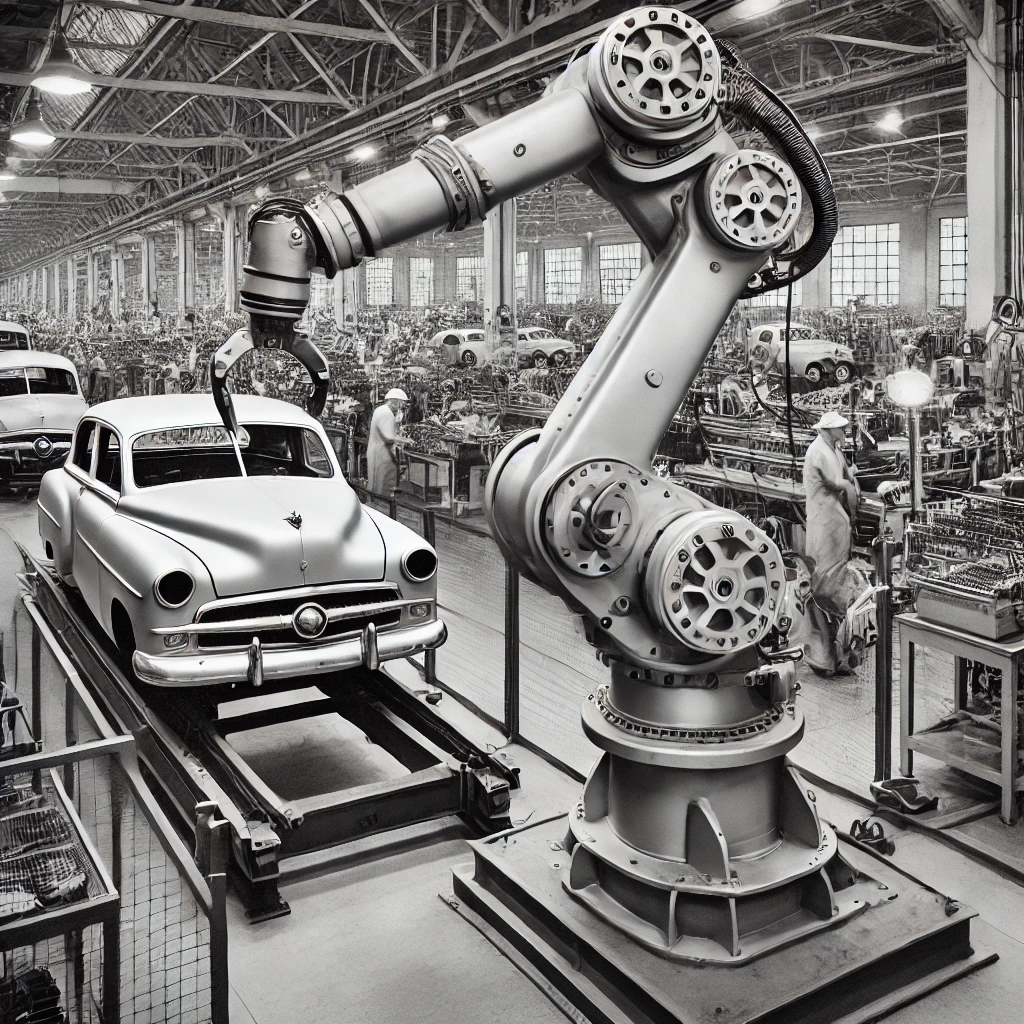
The first modern robot, as we think of them today, was created by George Devol in 1954. He invented the “Unimate,” a robotic arm used for industrial automation. It was later installed in a General Motors assembly line in 1961, marking the start of robotic automation in manufacturing.
The concept of robots has evolved over centuries, but the creation of modern robots began in the 20th century, with historical precedents dating even further back. Here’s a detailed timeline of the development of robots:
Early Automata (Pre-20th Century):
1. Ancient Greece and China: Early mechanical devices that mimicked life forms date back to ancient civilizations. For instance, Hero of Alexandria (1st century AD) created various mechanical devices, including an automated puppet theater and steam-powered mechanisms. In ancient China, around 400 BC, craftsmen are believed to have created automated figures.
2. Leonardo da Vinci (1495): Leonardo designed one of the earliest recorded humanoid automata, known as Leonardo’s Robot. His sketches revealed a mechanical knight capable of sitting, standing, and moving its arms, designed with gears and pulleys.
3. Jacques de Vaucanson (1738): This French inventor created one of the most sophisticated automata of his time, including a mechanical duck that could flap its wings, eat, and simulate digestion.
Modern Robot Development (20th Century Onward):
1. Karel Čapek’s “R.U.R.” (1920): Czech playwright Karel Čapek introduced the term “robot” in his play Rossum’s Universal Robots. The word “robot” comes from the Czech word “robota,” meaning forced labor or drudgery. While Čapek did not build a robot, his play presented the idea of artificial beings performing human tasks, igniting the imagination of future robotic engineers.
2. Tesla’s Remote-Controlled Boat (1898): Before robots as we know them, inventors like Nikola Tesla contributed to the field of automation. In 1898, Tesla demonstrated a radio-controlled boat, showcasing the possibilities of remote-controlled devices, an early form of autonomous machines.
3. W. Grey Walter’s Tortoises (1948–1949): Neurophysiologist Grey Walter created the first electronic autonomous robots in Bristol, UK, named “Elsie” and “Elmer.” These robots, also called “tortoises,” could navigate around obstacles and seek out light, an early exploration of artificial intelligence and robotic autonomy.
4. George Devol and Unimate (1954): The first modern robot, Unimate, was invented by American engineer George Devol in 1954. This was an industrial robotic arm designed for factory work. Devol’s invention was patented as “Programmable Article Transfer” and later commercialized by Joseph Engelberger, who is often regarded as the father of robotics. Unimate was first installed in a General Motors factory in 1961 to lift and weld parts, revolutionizing manufacturing through automation.
5. Shakey the Robot (1966-1972): Built by the Stanford Research Institute, Shakey was the first mobile robot capable of reasoning and navigating through its environment autonomously. It was one of the earliest examples of artificial intelligence applied in robotics, capable of performing tasks like analyzing its surroundings and planning routes.
6. Honda’s ASIMO (2000): Honda’s ASIMO (Advanced Step in Innovative Mobility) represents one of the most advanced humanoid robots. Unveiled in 2000, ASIMO could walk, run, climb stairs, and perform basic tasks. It demonstrated significant advancements in mobility, human interaction, and robot autonomy.Significance:Unimate’s Impact: The introduction of Unimate on the assembly line is regarded as a pivotal moment in robotics. It marked the transition from theoretical and entertainment automata to practical, industrial robots, paving the way for modern robots used in manufacturing, healthcare, and service industries.Evolution of AI and Robotics: Starting with simple automated machines like Walter’s tortoises, robots gradually integrated artificial intelligence, enabling more complex behaviors and decision-making. Modern robots, like Boston Dynamics’ Atlas and Spot, and collaborative robots (cobots) used in industry, continue to push the boundaries of what robots can do.In summary, the evolution of robots started with simple mechanical automatons in ancient times and progressed to the industrial automation of the 20th century, reaching the advanced humanoid and autonomous robots of today. George Devol’s Unimate, created in 1954 and put into use in 1961, is considered the first true modern robot in a practical, industrial sense.