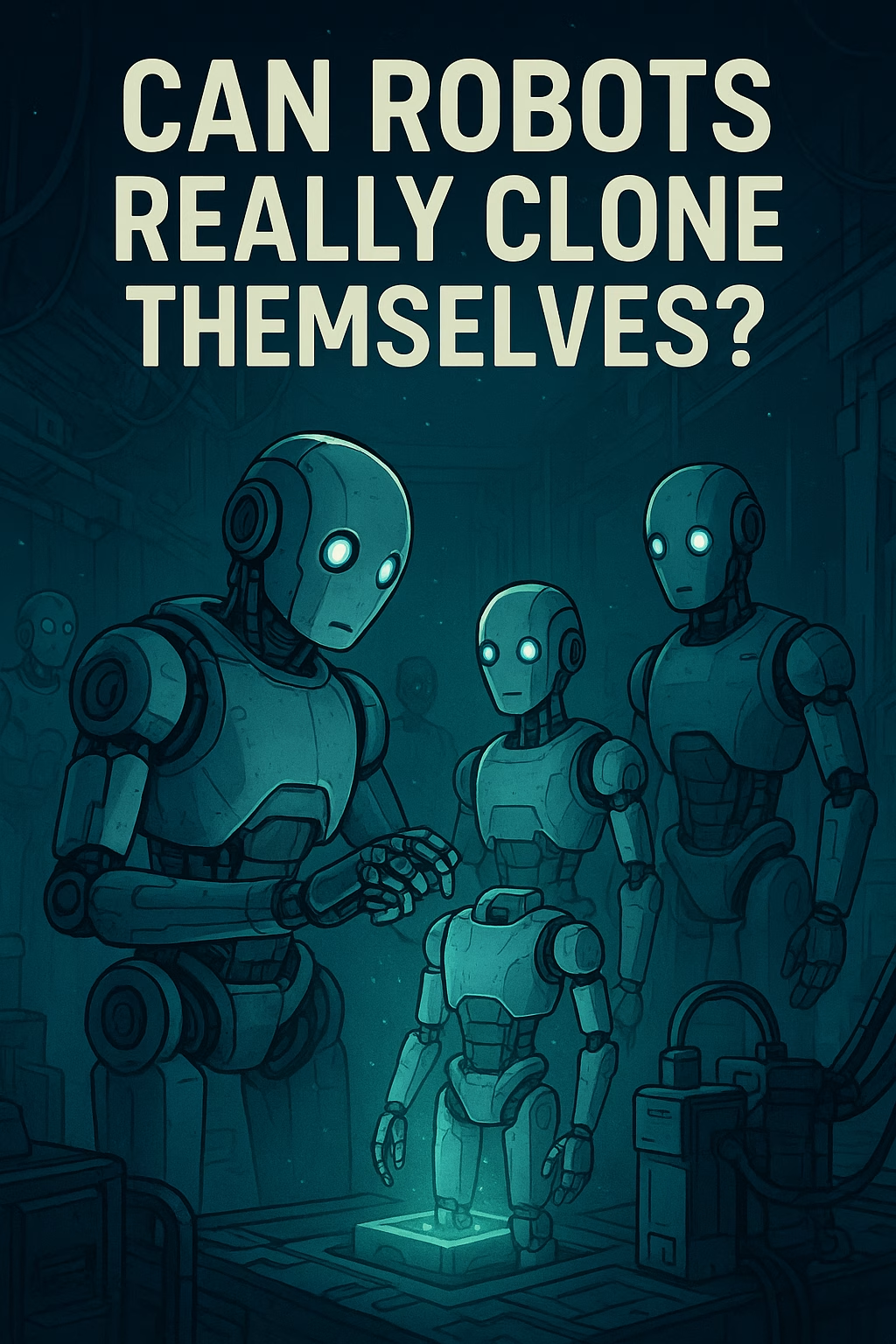
The concept of robots cloning themselves—or more technically, self-replicating robots—sounds like something out of a science fiction movie. But in science and engineering, this topic is actively studied as a possible future of robotics, manufacturing, and even space exploration.
🔹 What Does “Self-Replication” Mean?
In biology, replication means an organism produces an identical copy of itself. For robots, it would mean:
- A robot designs and assembles a copy of its own structure.
- The system uses available resources (materials, energy, components) to build this copy.
- The copy is functional and can also repeat the process.
At present, robots cannot truly “clone” themselves in the biological sense. However, researchers are experimenting with partial replication.
🔹 Current Examples and Experiments
- 3D Printing Robots
- A robot equipped with a 3D printer can manufacture some of its own parts (such as plastic joints or frames).
- However, complex parts like microchips, batteries, and sensors cannot yet be self-manufactured.
- Modular Robots
- These robots are made of many small units (modules) that can connect, disconnect, and rearrange.
- They can “reproduce” by splitting into two groups of modules, each functioning as a smaller robot.
- Laboratory Prototypes
- Research groups (including NASA) have investigated the idea of machines that could build copies of themselves on the Moon or Mars, using local resources (like lunar dust for raw materials).
🔹 Why Would We Want Self-Replicating Robots?
- Space Exploration 🚀: Robots could land on distant planets, build copies of themselves, and expand into large colonies without human help.
- Deep-Sea Operations 🌊: Inaccessible environments could be maintained by robots that repair or reproduce themselves.
- Sustainable Manufacturing 🏭: Factories might one day use self-replicating robotic systems to reduce labor and material transport.
🔹 The Challenges
- Complex Components: Chips, sensors, and high-precision motors cannot be built by a single robot without advanced industry.
- Energy: A robot needs a power source to function, but producing batteries or fuel cells is extremely complex.
- Control & Safety ⚠️: What if robots replicate uncontrollably? This is known as the “grey goo” scenario—a theoretical risk where machines multiply endlessly and consume resources.
🔹 Future Outlook
Scientists agree that true robotic cloning is not possible yet. Still, incremental progress is happening:
- Combining AI + 3D printing + modular robotics may one day allow robots to reproduce certain parts of themselves.
- In the far future, robotic colonies in space or on Earth could maintain themselves with minimal human intervention.
✨ Conclusion:
Robots cannot yet fully clone themselves, but the foundation is being laid with modular systems, 3D printing, and autonomous assembly research. The real challenge lies in producing complex components and ensuring safety. Self-replication in robotics might remain a science fiction dream for decades—but it is also one of the most fascinating frontiers of future technology.
💬 What do you think? Would self-replicating robots be humanity’s greatest invention—or our biggest risk?
👉 Sign in to our website and leave your comment below. We’d love to hear your thoughts!